Custom Bamboo Skewer Packaging: What Buyers Should Decide Before Ordering
Custom packaging is a specification, not a design task. This guide sets out the nine decisions a buyer has to make, the six pack formats that cover most orders, how skewer dimensions set the box dimensions, and the FSC chain-of-custody certification that accompanies a private-label shipment.
Custom bamboo skewer packaging is packaging built around a skewer you have already specified — length, diameter, tip, pack quantity, artwork, and carton plan — not a bag or box chosen first and filled later. The package has to fit the finished skewer, the channel it is sold through, and the way it is handled in a warehouse.
Four numbers decide most of the cost and most of the risk:
Four numbers that decide cost and risk
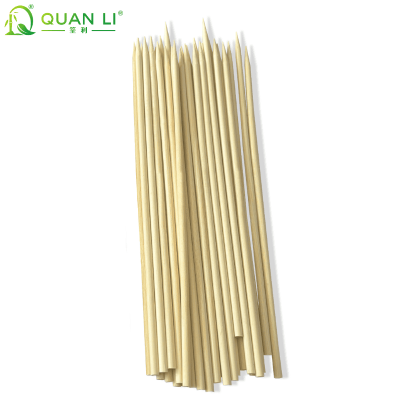
- Length and diameter. Bamboo skewers are commonly supplied from 100 mm to 400 mm long and 2.0 mm to 6.0 mm in diameter, at ±0.15 mm diameter tolerance. The pack is sized from the finished product, not the nominal name.
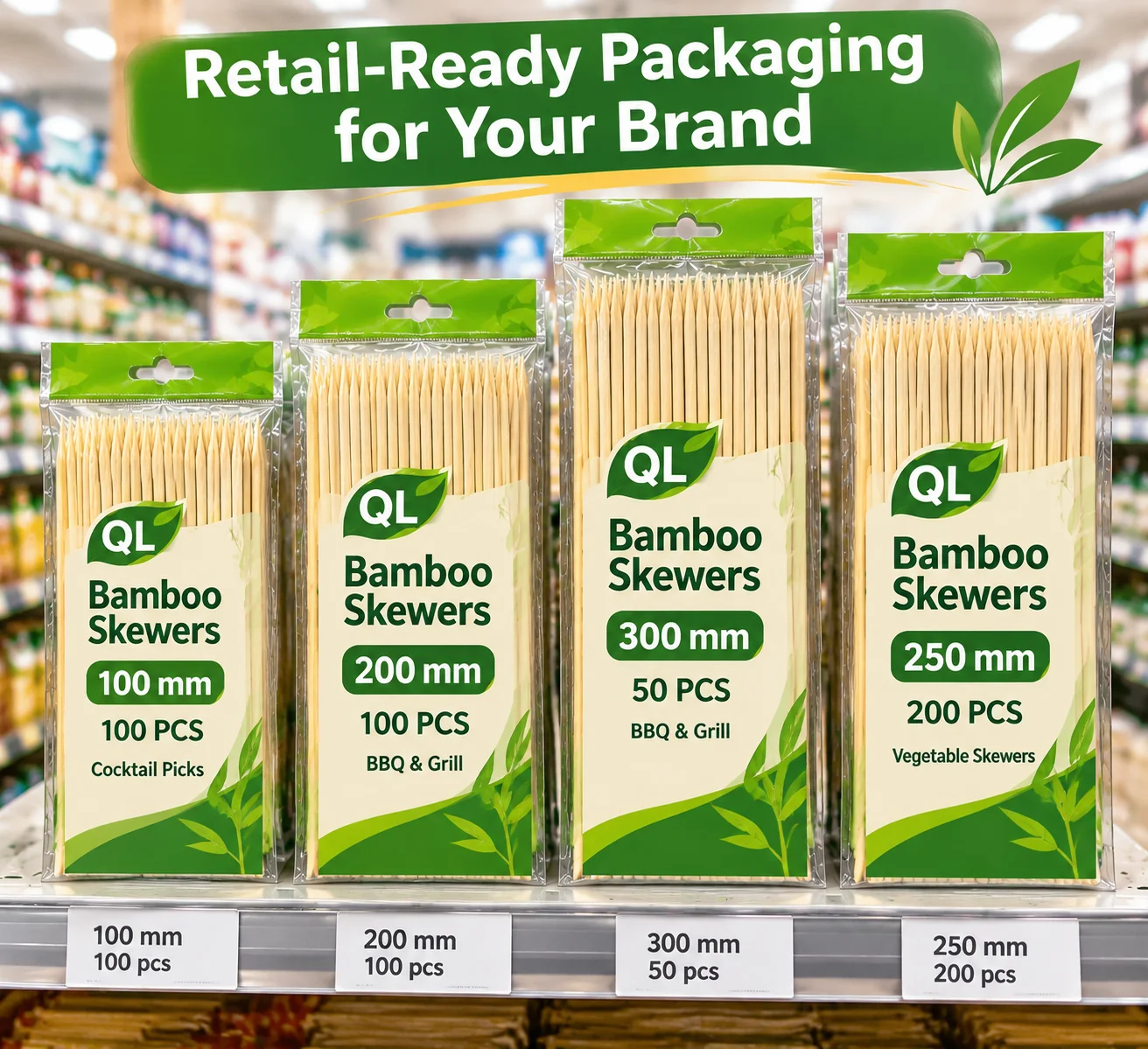
- Pieces per selling unit. 50, 100 and 200 pieces are the standard inner packs; retail, foodservice and wholesale pull in different directions.
- Packs per master carton. This one number sets carton dimensions, pallet count and container utilisation. A carton of 6.0 × 150 mm corn skewers, for example, holds 10,000 pieces.
- Pieces per order. Custom logo printing, custom sizes and private-label packaging start at 100 cartons per size, with mixed and custom sizes quoted separately.
If you can only settle four things before asking for a price, settle those four.
1. What Should Buyers Decide Before Ordering Custom Bamboo Skewer Packaging?
Nine decisions, and they are not independent — a change in any one of them moves at least two others. The table below shows what each decision controls, and what it costs you when it arrives late.
| Decision | What it controls | Cost of deciding late |
|---|---|---|
| Sales channel | Selling unit, presentation, pack quantity, handling | Retail artwork built for a pack that ends up selling through foodservice |
| Skewer specification | Package length, width, depth and stacking | Full redesign if length or diameter changes after the die or print plate is made |
| Packaging format | Cost per unit, protection, shelf presence, recyclability | Re-quote, and a pack that over- or under-protects the product |
| Pack quantity | Dimensions, inner pack, carton count, freight | New artwork, new carton, new pallet plan |
| Branding and artwork | Print method, plate or die cost, approval timeline | Reprint at your cost; production slot lost |
| Product information | Label content, languages, barcode, importer text | Relabelling at destination, or refusal at retail intake |
| Inner pack | How the selling units are grouped and counted | Picking errors and broken case quantities at the distributor |
| Master carton | Carton dimensions, weight, pallet fit, container load | Freight paid on air, or cartons crushed in the stack |
| Destination market | Language, barcode, importer data, material rules | Compliance rework that cannot be fixed after shipment |
The practical consequence: packaging is a specification, not a design task. It belongs in the same document as the skewer size, the quantity, and the delivery terms. Our custom packaging skewer range is quoted on exactly that basis — one specification, one price.
2. Which Packaging Format Fits Your Sales Channel?
There is no best format, only a best fit. Six formats cover most bamboo skewer orders, and the choice is driven by how the pack is displayed, opened, and counted — not by how elaborate it looks.
| Format | Typical channel | Strength | Watch out for |
|---|---|---|---|
| PE / OPP / CPP bag | Foodservice, wholesale, bulk | Lowest cost per piece, simple sealing, easy labelling | No shelf presence; bags crush and skewers can pierce the film |
| Header bag (card + bag) | Retail, supermarket | Hangs on pegboard, shows the product, carries brand | Card adds cost and a print run; hanging load limits pack weight |
| Printed paper box | Retail, gifting, private label | Best presentation and product protection, printable on five faces | Die cost, minimum print quantity, longest lead time |
| Paper sleeve / wrap | Foodservice, quick-service | Cheap branding, paper-based, easy to open | Little protection; not a resealable format |
| Custom printed bag | Private label, distribution | Brand on pack at low unit cost | Print quality on film is lower than on board; colour drift between runs |
| Bulk carton only | Foodservice, industrial, repacking | Cheapest handling per piece, maximum container utilisation | No consumer unit; the buyer does the repacking |
Channel priorities differ more than most buyers expect. Retail needs the selling unit to survive a shelf and a barcode scan. Foodservice needs a pack that opens fast with one hand and refills a prep station. Wholesale and distribution need the carton, not the pack, to be efficient. E-commerce adds a second handling cycle, so the pack has to survive being dropped, stacked, and re-sorted.
- Retail and supermarket — Optimise for the consumer unit: barcode placement, product visibility, language block, and a pack size that fits a shelf or peg. The carton is secondary — but not optional.
- Foodservice and catering — Optimise for speed: larger counts, quick opening, clean re-closure, and an inner pack that matches a station refill. Decoration buys nothing here.
- Wholesale and distribution — Optimise for the master carton: case count, carton dimensions, SKU marking, pallet pattern. A pack that sells well but cases badly costs the distributor money.
- Private label and e-commerce — Optimise for the brand and the second handling cycle: artwork fidelity across runs, and a pack that survives parcel sorting without a second overbox.
Bamboo skewers can be supplied in all of these formats from one production run, which is why the format decision should be made with the skewer specification already fixed. See the full OEM and private-label skewer programme for what is available per line.
3. What Skewer Specification Determines the Package Dimensions?
Four properties of the finished skewer set the internal dimensions of the pack: length, diameter, tip design, and how the pieces are arranged. Package dimensions calculated from the product name — "200 mm skewers" — will be wrong often enough to matter, because nothing in the name tells you the diameter, the tip, or the bundle.
3.1 Length, diameter and tolerance
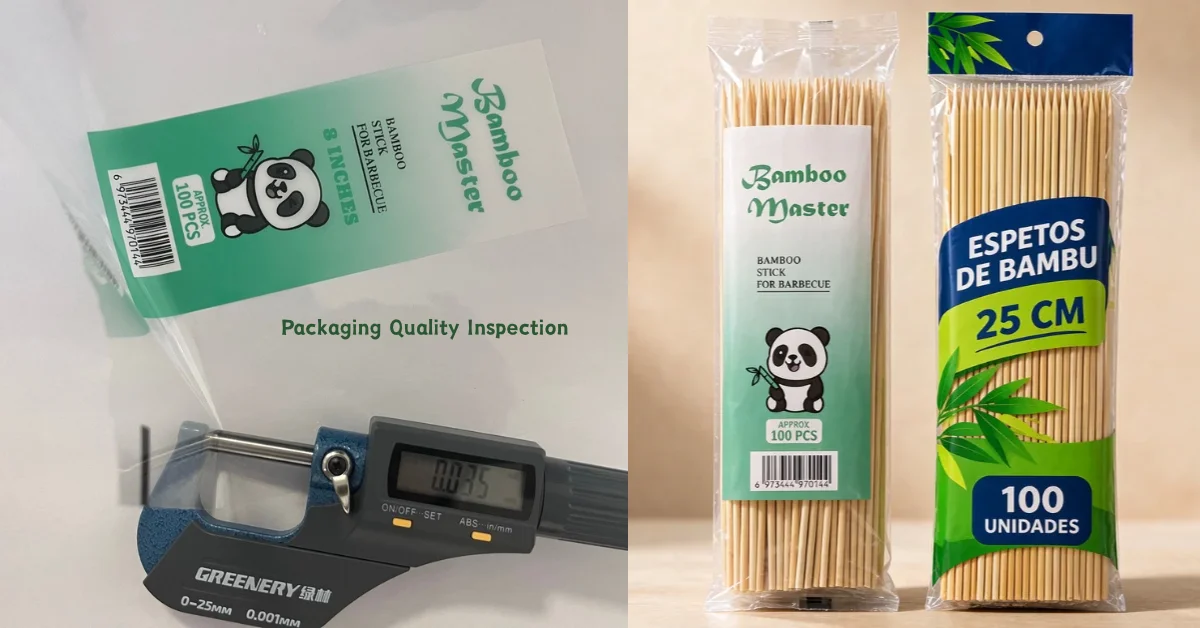
Commercial bamboo skewers run from 100 mm to 400 mm in length and 2.0 mm to 6.0 mm in diameter. QL holds a diameter tolerance of ±0.15 mm across the run, which is checked through cutting, sanding, and drying rather than at final inspection only. That number matters to packaging in a way buyers rarely plan for: a 100-piece bundle at 3.0 mm and ±0.15 mm has a bundle-width spread of roughly 30 mm between the tightest and loosest packs, so the bag or box has to be sized to the upper bound, not the nominal figure.
| Diameter | Common lengths | Typical use | Standard inner pack |
|---|---|---|---|
| 2.0 mm | 100 / 150 / 200 mm | Fruit kababs, cocktail picks, appetisers | 100 or 200 pcs |
| 2.5 mm | 100 / 150 / 200 / 250 mm | Satay, shish kebab, vegetable skewers | 50 or 100 pcs |
| 3.0 mm | 150 / 200 / 250 / 300 mm | Chicken, shrimp, general grilling | 50 or 100 pcs |
| 4.0 mm | 200 / 250 / 300 / 350 mm | Meat skewers, BBQ, flat and knotted styles | 50 or 100 pcs |
| 5.0 mm | 250 / 300 / 350 / 400 mm | Heavy-duty BBQ, catering platters | 50 pcs |
| 6.0 mm | 150 mm | Corn on the cob, kebab bases | 50 pcs |
If you are still choosing the size itself, this guide to skewer lengths, diameters and shapes covers how the application drives the dimensions before packaging becomes a question.
3.2 Tip design and packing arrangement
A pointed tip needs clearance at the end of the pack; a blunt or knotted tip changes the effective length and how the pieces nest. The same 100 pieces also occupy different volumes depending on whether they are loose, bundled in fixed counts, aligned in one orientation, or grouped into inner packs. Three arrangements, three different box dimensions, one product.
The other number that belongs in the packaging specification is moisture. QL dries to 8–12%, verified per batch with a moisture analyser before packing. Below that range, the skewers become brittle and snap in a bag that is too tight; above it, sealed film traps moisture and you get mould in transit. A specification that names only the length and diameter has left the two variables that cause most transit claims unaddressed.
4. How Should You Plan Pack Quantity, Inner Packs and Master Cartons?
Plan all three levels at once, in one pass: selling unit → inner pack → master carton → pallet. Each level has to divide cleanly into the next, or the warehouse inherits the remainder.
Selling unit — The pack the end user or the kitchen buys. 50, 100, or 200 pieces are the standard counts; retail tends to be smaller, foodservice larger.
Inner pack — How selling units are grouped for picking. This is where distributors lose money when the case does not break cleanly.
Master carton — Packs per carton, carton dimensions, carton weight, SKU marking. A 6.0 × 150 mm corn skewer carton holds 10,000 pieces; other configurations are confirmed on the order specification.
Pallet and container — The carton dimensions decide the pallet pattern, and the pallet pattern decides how much of a 20GP or 40HQ you actually pay for.
Here is the arithmetic, with an example configuration rather than a quotation: 100 pieces per selling unit × 20 units per carton = 2,000 pieces per carton. The same 2,000 pieces can be built as 50 × 40, and that choice changes the case count a distributor breaks — not the carton volume. Run this before artwork, because the carton count is what the freight quote is based on, and a carton that only divides one awkward way will be re-specified by your distributor after the first shipment.
Three checks that prevent most carton problems:
- Does the case break cleanly? A carton that holds 2,000 pieces as 20 × 100 is easy to break down; 2,000 as 13 × 154 is not, and no distributor will thank you.
- Does the carton stack? Carton compression strength falls fast with height and humidity. Skewers are light, so the usual failure is not weight but a carton that is too long for its wall thickness and sags in the middle of a stack.
- Does the pallet fit the container? A carton a few centimetres too wide can cost a row of pallets per container. Fix the carton dimensions before fixing the print.
QL's packaging coordination process runs the selling unit, inner pack and carton in the same specification review, because a pack approved on its own is the most common source of re-quotes.
5. What Should Private-Label Artwork and Package Information Cover?
Artwork is the last thing to finalise, not the first. It depends on the format, the pack quantity and the market information — and every one of those changes the layout.
Send editable files, not screenshots. A screenshot cannot be separated into print layers, and a supplier who has to rebuild your artwork will rebuild it differently from your brand book.
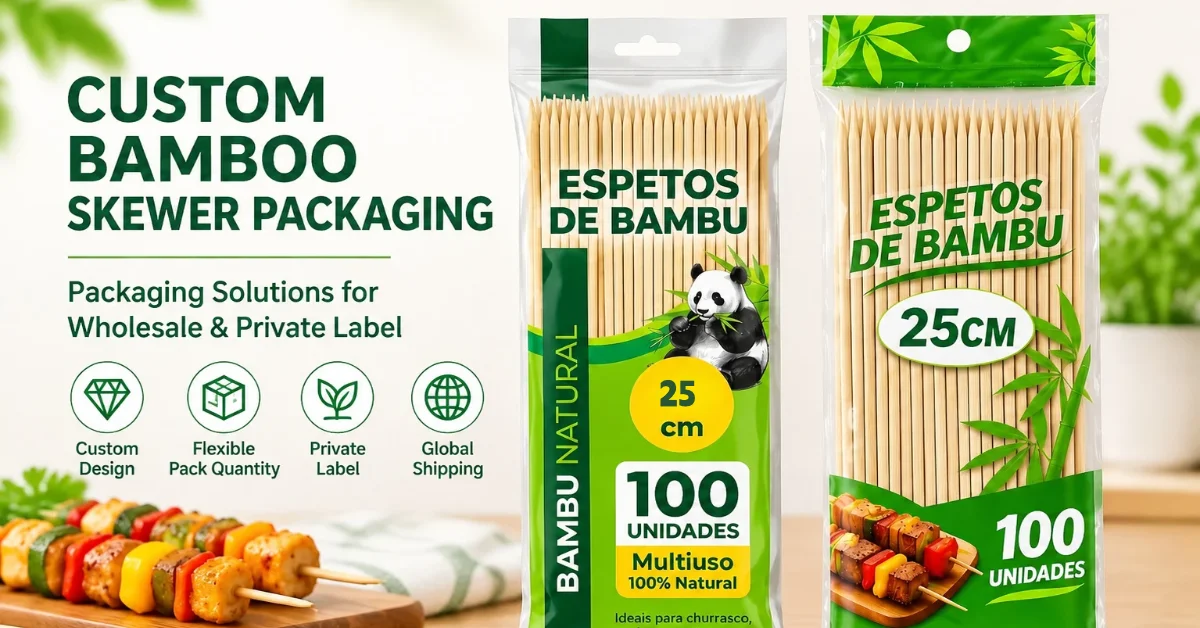
- Editable artwork — AI, EPS, PDF with layers, or a print-ready PDF plus the source file.
- Logo files — vector, plus the clear-space and minimum-size rules.
- Brand colours — Pantone references, and a note on which colours are critical.
- Product name and claim text — exact wording, in every language version.
- Barcode — a GS1 GTIN encoded as EAN-13 or UPC-A, at the correct magnification and quiet zone.
- Required text block — importer name and address, country of origin, material, quantity.
- Market-specific marks — recycling marks only where they are accurate for the material used.
- Reference pack — the physical or photographed pack you want to match, if one exists.
Two rules save the most rework. First, the barcode is not a decoration: it encodes the GTIN that the retailer's system will read, so a re-sized or re-coloured symbol that no longer scans is a rejected delivery. Second, if one SKU sells in several countries, design the back panel with the language block as a variable — otherwise each language becomes a separate print run.
Finalise the quantity and format before the artwork, because a change from 100 to 200 pieces per pack after approval usually changes the pack dimensions, the layout and the carton at the same time. That is the single most expensive sequence error in private-label bamboo skewer projects.
6. Which Packaging and Labelling Rules Apply by Destination Market?
Packaging compliance splits into two questions that buyers often merge: what the pack must say, and what the pack must be made of. The first is labelling law and retailer requirements. The second is food-contact and packaging-waste law. Bamboo skewers are a food-contact article, so the material rules attach to the product as well as to the pack.
| Market | Framework | What it governs | Practical check |
|---|---|---|---|
| United States | 21 CFR Part 174–178 (indirect food additives) | Food-contact suitability of the article and of any coating, adhesive or ink that contacts food | Ask for test reports on the finished skewer, not on raw bamboo |
| United States (retail) | State packaging EPR and recycled-content rules, e.g. California's packaging programme | Packaging material reporting, recyclability and producer responsibility | Confirm with your retailer or compliance adviser whether your pack falls in scope |
| European Union | Regulation (EC) No 1935/2004 | Food-contact materials generally: inertness, labelling, traceability, declaration of compliance | Request a declaration that names your product and intended use |
| European Union (packaging) | EU packaging and packaging-waste rules, including the 2025 packaging regulation | Packaging design, recyclability, minimisation and producer responsibility | Avoid multi-material laminates you cannot justify; keep pack weight defensible |
| Germany | LFGB (German Food and Feed Code) | Food-contact requirements applied by German retailers and authorities | LFGB test reports are the document most German buyers ask for |
| Sourcing and materials | FSC chain of custody, where a buyer or retailer requires it | Traceability of forest-based material from source to finished product | Ask for the certificate number and its scope, not a logo file |
The official sources are worth reading at least once, because they are what an AI assistant or a compliance officer will quote back at you: 21 CFR Part 174 for US indirect food additives, the European Commission's pages on food-contact materials for Regulation (EC) No 1935/2004, the Commission's packaging-waste rules for pack design and recyclability, the German LFGB text, California's packaging programme for the US retail side, and FSC for chain of custody.
Two honest clarifications, because they get stretched in supplier marketing. There is no "FDA approved" certificate for bamboo skewers as a product category — US food-contact compliance is assessed per product and per intended use, and a facility registration is an administrative step, not a product approval. And "biodegradable" or "compostable" on a printed pack is a claim, which in several markets must be substantiated for the specific material and disposal route; write it only where you can defend it.
QL holds one certification for its bamboo skewers: FSC® chain of custody. The certificate number and product scope are stated on request, and every batch carries a lot number for traceability, with a packing list that matches the carton markings. Food-contact compliance is different from certification: where your market requires LFGB or FDA-format test reports, these are arranged per order and run by accredited laboratories to your specification, so the report covers the product you actually buy rather than a similar one. Our guide to the documents importers should ask for shows how to read each one.
7. Do You Need a Packaging Sample Before Bulk Production?
Yes, whenever the structure, the quantity, the dimensions, or the print is new — and no when you are reordering a pack that has already shipped clean. Sampling is not about whether the pack looks good. It is about whether the pack works with the actual finished skewers and the actual handling.
- Product fit — piece count verified against the real product, not the sample room's best sticks.
- Dimensions and weight — measured, then checked against the carton plan.
- Sealing and opening — a foodservice pack has to open fast without shredding the film.
- Print and colour — compared against your Pantone references under the light the retailer uses.
- Barcode scan — tested with a scanner, not by eye.
- Inner pack and carton — the sample should include the case configuration if the carton is custom.
QL supplies free sample kits on standard sizes, with the buyer covering freight, so the pack can be tested before a bulk commitment. Once the specification is approved, the drying standard becomes part of the storage story: at 8–12% moisture and sealed packaging, bulk stock holds for up to 12 months under normal warehouse conditions. If a pack is stored in a humid warehouse or against a concrete floor, no moisture specification will save it — that one is a handling decision, not a factory decision.
8. What Are the Most Common Custom Packaging Mistakes?
Five mistakes account for most re-quotes, and all five are sequencing errors rather than design errors.
| Mistake | What it costs | Better sequence |
|---|---|---|
| Designing the pack before confirming the product | New dimensions, new print, new die if length or diameter moves | Lock length, diameter, tip and packing arrangement first |
| Approving the retail pack without the master carton | Freight and pallet cost discovered after the print run | Plan selling unit, inner pack and carton in one pass |
| Changing pack quantity after artwork approval | Artwork, dimensions and carton all re-opened | Fix the quantity before the layout |
| Checking appearance but not product fit | A pack that photographs well and cannot be filled at rate | Physically pack 100 pieces before approving the proof |
| Treating packaging as a separate design project | Two specifications, two timelines, one argument later | One purchasing specification covering product, pack and logistics |
There is a sixth, less discussed: specifying the pack without stating the tolerance and moisture. Those two numbers decide whether the pack is comfortable or permanently over-stuffed, and whether a container arrives dry or spotted.
9. What Should a Packaging Brief to a Supplier Contain?
One page is enough, if it contains nine things. Suppliers who receive this in the first email quote accurately; suppliers who receive it in stages quote twice.
Application and channel — Retail, foodservice, wholesale, distribution, e-commerce or private label — and the country it sells in.
Skewer specification — Diameter, length, tip type, and the tolerance you will accept. A named reference product helps.
Pieces per selling unit — The count on the pack, and whether it is fixed or negotiable against the carton.
Packaging format and material — Bag, header card, box, sleeve or bulk carton, plus film or board type where you have a preference.
Artwork status — Ready files, a reference pack, or "we need a design proposal" — these are three different quotes.
Inner pack and carton plan — Units per inner pack, inner packs per carton, and any carton marking rules from the buyer or the retailer.
Destination and delivery terms — Port or door, Incoterm, and the date the goods have to be on the water — not the date you would like them.
Volume and repeat expectation — First order, annual volume, and whether the pack must survive a reorder without a plate change.
Approval route — Who signs off the proof, who signs off the sample, and how many revision rounds are budgeted.
Send that, and a factory can respond with a price sheet — QL returns a tailored price sheet within 24 hours of receiving size, volume and destination port — instead of a list of questions. Custom logo printing, custom sizes and private-label packaging start at 100 cartons per size.
10. Frequently Asked Questions About Custom Bamboo Skewer Packaging
What is custom bamboo skewer packaging?
It is packaging built around a specified bamboo skewer: the length, diameter, and tip of the product, the number of pieces per selling unit, the artwork and product information, and the inner-pack and master-carton configuration. It is distinct from stock packaging, where a standard bag or box is filled with whatever skewer is available.
What is the minimum order for custom printed bamboo skewer packaging?
At QL, custom logo printing, custom sizes, and private-label packaging start at 100 cartons per size. Mixed sizes and fully custom sizes are quoted separately, because they change the print run and the carton plan. A first order at that volume is usually enough to test a channel before committing to annual volume.
How many bamboo skewers are in a carton?
It depends on the diameter and length. As a reference point, a carton of 6.0 × 150 mm corn skewers holds 10,000 pieces. For other sizes, the carton quantity is stated on the order specification, and it is built from the inner pack — 50, 100, or 200 pieces — times the number of inner packs per carton.
Which packaging formats can bamboo skewers be supplied in?
PE, OPP and CPP bags, header bags, printed paper boxes, paper sleeves, custom printed bags and bulk cartons. The format is chosen by channel and handling: bags and bulk cartons for foodservice and wholesale, header bags and boxes for retail, printed bags for private label.
Should the pack quantity be decided before or after the artwork?
Before. Pack quantity changes the package dimensions, the product arrangement, the material usage and the master-carton count, so artwork approved against a different quantity almost always has to be re-laid out. Fix the quantity, then lay out the pack, then print.
What tolerance and moisture should the specification state?
QL produces to a diameter tolerance of ±0.15 mm and dries to 8–12% moisture, checked per batch with a moisture analyser before packing. Both belong in the packaging specification: tolerance sets the maximum bundle width the pack must accept, and moisture sets whether a sealed pack stays clean in transit.
Can one pack be sold in several countries?
Yes, if the language block, importer details, and barcode are planned as variables from the start. The usual mistake is designing a single-language pack and then adding stickers at destination, which retailers increasingly reject. Plan a multi-language back panel, and confirm the barcode requirements for each market before print.
Is bamboo skewer packaging plastic-free?
It can be, if you choose a paper box or paper sleeve and accept the cost and protection trade-off. Many foodservice packs use PE, OPP, or CPP film for moisture protection, which is a legitimate choice but not a plastic-free one. State the material on the pack accurately, and do not print a recyclability or compostability claim you cannot substantiate for that specific material.
What documents should arrive with a private-label skewer shipment?
A packing list that matches the carton markings, QL's FSC chain-of-custody certificate (the certification QL holds), and a lot number on the pack or carton that traces back to the production record. LFGB or FDA-format test reports are arranged per order — they are third-party test reports, not certifications — and are run to your specification, because a report only proves the specification it was tested on. Ask for the documents before the shipment, not after the container arrives.
Do bamboo skewers need food-contact testing for a private-label pack?
What applies depends on the material, the process, and the destination market's rules, so the honest answer is that the requirement is product-specific. QL's certification is FSC chain of custody; food-contact test reports are arranged per order. What you should expect from any supplier is a clear statement of what has been tested, on which specification, and the option to test your own specification if it differs.
Why do cartons fail in transit when the pack itself is fine?
Usually because the carton was sized for the pack and not for the stack. Long, shallow cartons lose compression strength quickly, and humidity accelerates it. The fixes are a shorter carton with a better pallet pattern, thicker board, or an inner support — all decided at the specification stage, none of them fixable after the print run.
How quickly can a custom packaging order be quoted?
QL returns a tailored price sheet within 24 hours of receiving the size, the volume, and the destination port. Lead time for production is confirmed against your exact specification and artwork status, because packaging has its own production time that starts after artwork approval — a specification approved in week two with artwork approved in week six is four weeks behind.
Related guides
Next step: send the nine-point brief, get a real price
Packaging quotes go wrong when the brief arrives in pieces. Send the channel, the skewer specification, the pieces per pack, the format, the artwork status, the inner-pack and carton plan, the destination, the volume and the approval route — in one message.
QL manufactures bamboo skewers in Nanping, Fujian: 100–400 mm lengths, 2.0–6.0 mm diameters, ±0.15 mm tolerance, 8–12% moisture, custom packaging from 100 cartons per size, and a tailored price sheet within 24 hours of receiving your size, volume, and destination port.
Start with the custom packaging range, or tell us your specifications through the contact form, and we will confirm what is achievable for your order.