The Bamboo Straw Surge: Decoding the 2026–2036 Market Shift
A Multi-Billion Dollar Paradigm Shift
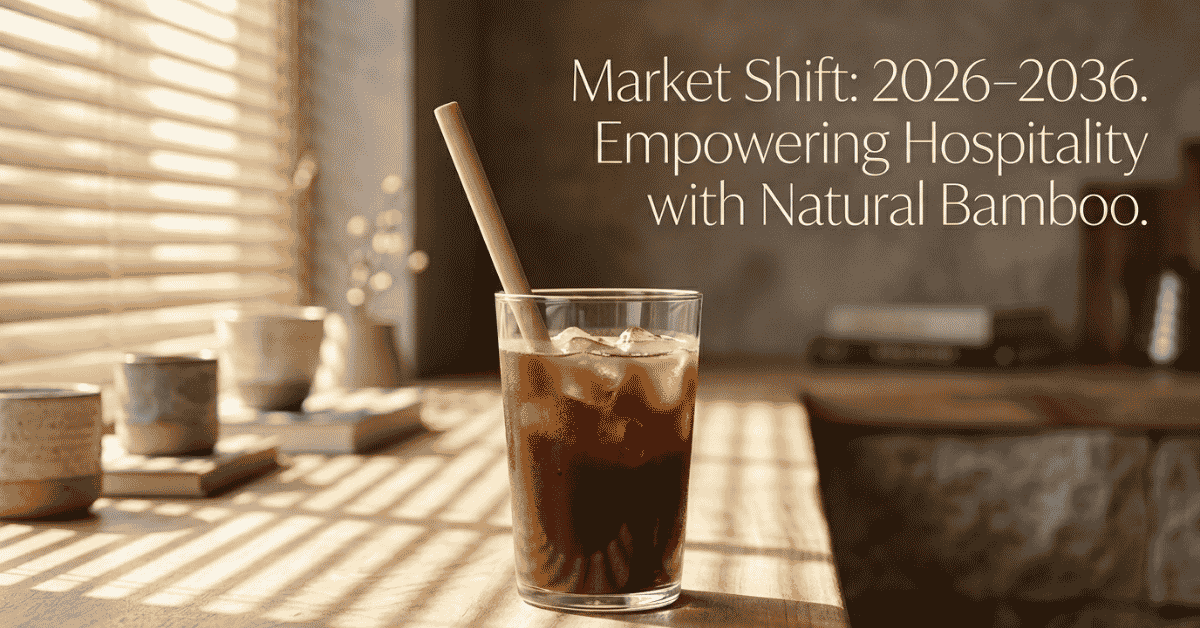
A market study by Future Market Insights (FMI) signals a permanent shift for the hospitality and retail sectors. According to the Global Bamboo Straw Market 2026–2036 report, the global valuation for bamboo straws sits at USD 2.28 billion in 2026 and is projected to reach USD 4.31 billion by 2036—a robust 7.3% CAGR that nearly doubles the market over the next decade.
For procurement managers and food-service franchise owners, transitioning away from single-use plastics is no longer a temporary trend but a standard procurement requirement. Choosing natural materials has become a strategic imperative to secure inventory longevity and align with tightening international supply chain compliance.
Understanding the Numbers: Reusability Leads the Market
The core data within the FMI report reveals critical indicators that large-scale buyers must evaluate when optimizing their upcoming inventory allocations:
The Dominance of Reusable Options:
Reusable bamboo alternatives have captured a definitive 52% share of the global product segment. Commercial buyers are heavily favoring durable, multi-use profiles over single-use items to minimize waste overheads.High-Volume Application Sectors:
Restaurants and coffee shops constitute the primary demand drivers, commanding 41% of global market utilization. This commercial concentration demands that alternative products maintain absolute structural consistency to handle high-frequency hospitality environments.Accelerating Western and Regional Markets:
Driven by intensifying plastic bans, major economies are seeing rapid market expansion. Germany is leading European growth with a projected 7.1% CAGR, while the United States market is expanding at a robust 8.0% CAGR over the forecast period.Mitigating Sourcing Risks: Material Consistency at Scale
While the market demand is expanding rapidly, the FMI report openly addresses the operational bottlenecks that commercial buyers frequently encounter. Early-stage market fragmentation often leaves buyers struggling with fluctuating raw material quality, non-standardized diameters, and poor durability across large volume batches.
To eliminate these supply chain vulnerabilities, procurement departments must partner with established manufacturing entities capable of delivering strict material standardization. Securing raw material access from mature bamboo forestry clusters ensures that incoming inventory maintains consistent wall thickness, high tensile strength, and precise caliber dimensions across multi-container shipments.
Fulfilling Enterprise Demand with QL
As an experienced global supply chain partner,QL is fully equipped to meet this rising international demand. By leveraging the natural physical durability of premium Moso bamboo and employing strict structural caliber controls, we address the exact consistency challenges highlighted in the latest industry forecasts.
Our bulk export operations provide global hospitality distributors and retail chains with a dependable, legally compliant pipeline of high-grade bamboo straws. When choosing QL, enterprise buyers secure a reliable fulfillment framework optimized for smooth customs clearance, efficient large-scale palletization, and long-term supply chain predictability.