From Traditional Manufacturing to Automation: Changes in Bamboo Product Production
The bamboo products industry is gradually shifting from labor-intensive processing to more mechanized and automated manufacturing. As global buyers place greater emphasis on product consistency, production efficiency, and reliable bulk supply, manufacturers are adopting new equipment and improving their production processes. Unlike many industrial materials, bamboo varies naturally in diameter, thickness, and structure. This makes processing and quality control important at every stage of production. Traditional bamboo manufacturing relies heavily on manual cutting, splitting, shaping, and polishing. Today, specialized machinery is increasingly used to handle repetitive production tasks. Common developments include: These technologies help manufacturers improve processing efficiency and establish more consistent production procedures. For bulk buyers, consistent product specifications are essential. Automated equipment helps manufacturers control dimensions such as length, width, and thickness through repeatable processing settings. Mechanical polishing can also improve surface smoothness, while inspection equipment supports the identification of visible defects and dimensional variations. However, automation does not replace quality management. Raw material selection, machine adjustment, and regular inspection remain important for maintaining product standards. When evaluating a bamboo product supplier, buyers should look beyond the number of machines in the factory. Consider checking: A well-organized production process combines suitable equipment with clear quality standards and effective inspection procedures. At Fujian QUAN LI Houseware Manufacturing Co., Ltd. (QL Bamboo), specialized machinery is used across multiple bamboo processing stages, including automated cutting, robotic material handling, multi-blade splitting, peeling, and knot removal. Moisture content is controlled at no more than 12% before finishing. The process also includes dry buffing and food-wax polishing to improve surface smoothness. By combining mechanized processing with production monitoring and quality inspection, QL Bamboo continues to develop its manufacturing processes to support consistent product specifications and bulk supply requirements. Automation is changing bamboo product manufacturing, from raw material processing to finishing and quality inspection. For buyers, the key is to evaluate how machinery, production procedures, and quality management work together to meet order specifications. As the industry develops, these improvements will continue to shape the way bamboo products are manufactured and supplied to global markets. Related Bamboo Products from QL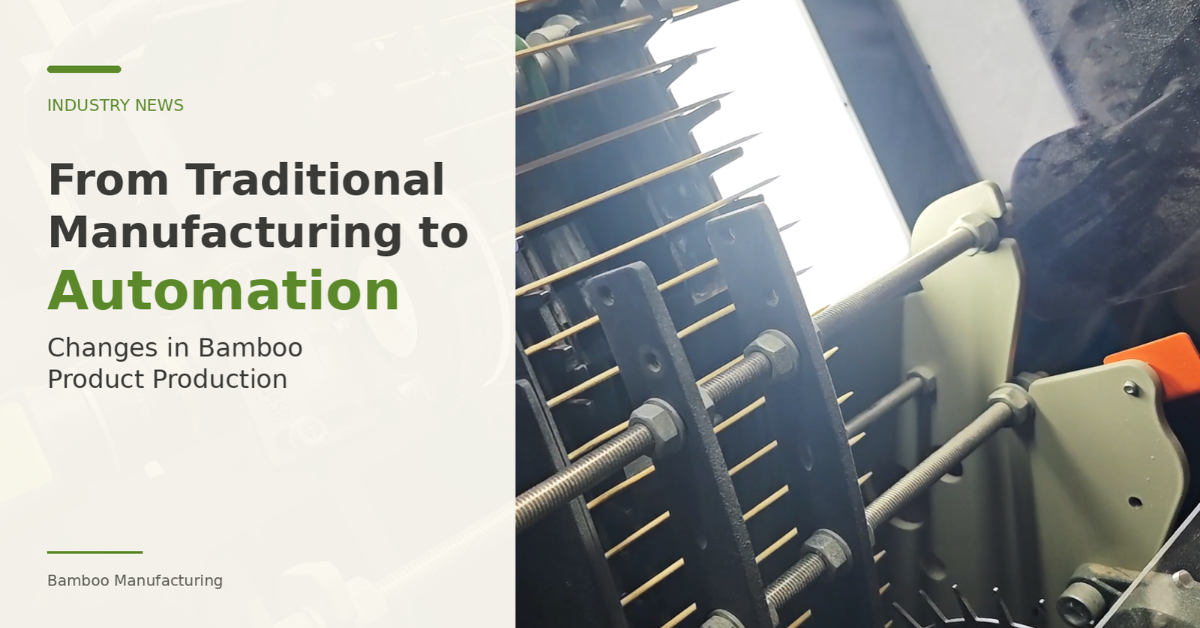
1. From Manual Processing to Automated Production
2. How Automation Improves Product Consistency
3. What Buyers Should Look for in an Automated Factory
4. QL Bamboo's Approach to Mechanized Production
Conclusion