The Buyer's Checklist: How to Spot Quality Bamboo Skewers in 30 Seconds
Last month, a restaurant owner called us in a panic. She'd ordered 10,000 bulk bamboo skewers from a new supplier—great price, fast shipping, everything looked perfect. Then her staff started prepping for a weekend catering event. Half the skewers snapped while threading chicken. The other half had rough spots that left splinters in the meat.
She ended up scrambling to find replacements at 9 PM on a Friday night, paying triple for rush delivery.
"How was I supposed to know?" she asked. "They all looked the same in the photos."
The Hidden Truth of Product Listings
Here's the truth: Quality bamboo skewers and cheap knockoffs can look identical in product listings.
The difference only shows up when you're holding them, using them, or—worst case—dealing with customer complaints. After two decades making bamboo products, I've seen every shortcut factories take to cut costs. Some are harmless compromises. Others? They'll cost you more than you saved, plus your reputation.
Today we're showing you exactly what to look for, so you never end up making that panicked Friday night call.
The Quick Visual Check: What You Can See Right Away
When you first open a box of bamboo skewers, here's what separates the good from the questionable.
1. Color Consistency Tells You About Age Control
Premium skewers have uniform color throughout the batch—ideally a consistent light golden-brown. This tells you the bamboo came from the same harvest and the same age group (4-5 years). Cheap skewers often show wild color variation: some pale yellow, some dark brown, some greenish. This screams "mixed harvest"—using different ages and sources to save money.
Why it matters: Bamboo age affects strength. Mix 3-year (weak) with 6-year (brittle) bamboo, and you get unpredictable performance.
2. Surface Smoothness Reveals Processing Standards
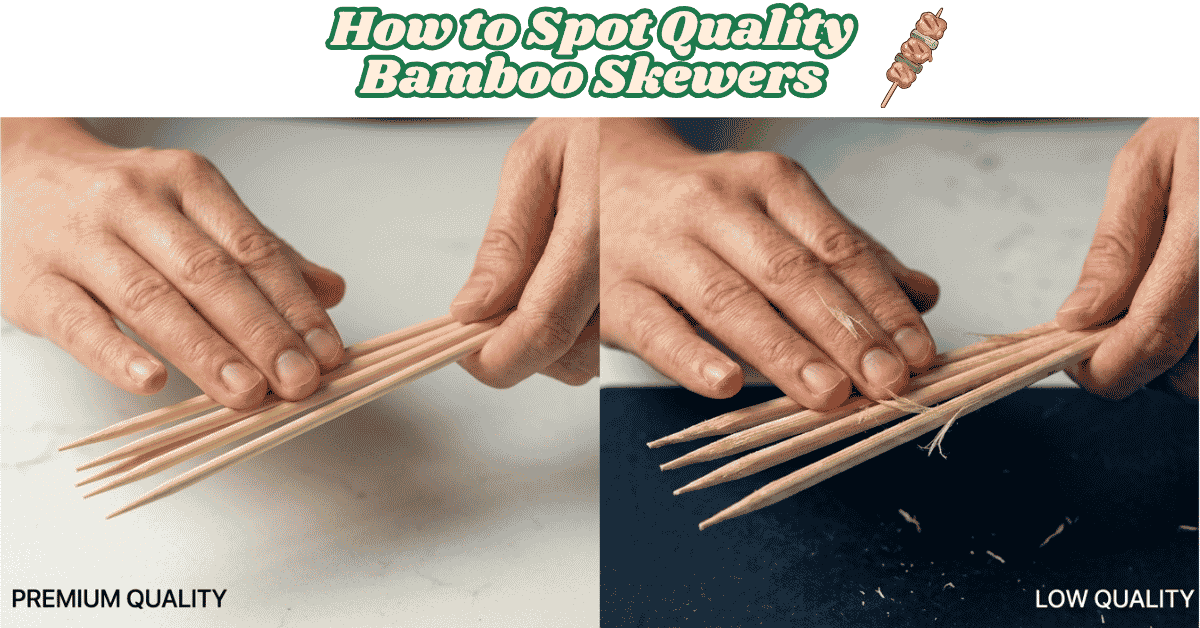
Run your finger along a premium skewer; it should feel silky, with no catches. This comes from double-polishing: a dry polish to remove fibers, followed by a final finish with food-grade compound. Cheap manufacturers skip the second polish. The result looks "fine" at first, but tiny fibers remain attached.
The Test: Rub the skewer between your palms like starting a fire. Premium skewers stay smooth. Cheap ones start to "fuzz up," releasing particles into your customer's food.
3. Diameter Consistency Shows Production Control
Pick up five random skewers and line them up. Premium skewers are nearly identical in thickness, thanks to digital calibration. Cheap operations use poorly maintained equipment. Their skewers taper unevenly or vary wildly between pieces—some feel like toothpicks, others like sticks.
The Physical Tests: Performance in the Kitchen
Visual inspection catches obvious problems, but real differences emerge during use.
1. The Flex Test Reveals Fiber Quality
Gently bend a skewer into a shallow arc—just enough to feel resistance. Premium skewers resist evenly and spring back to straight. This indicates dense, mature fibers with good lignin content. Cheap skewers feel either too stiff (brittle) or too flexible (immature). Uneven flexing is a preview of how they will fail mid-service.
2. The Pierce Test Simulates Real Use
Try piercing a dense vegetable like a carrot or raw potato. A quality skewer slides through with steady pressure, staying straight without bowing. Cheap skewers might bend, split along the grain, or have tips that "mushroom" instead of pierce.
Pro Tip: Try this with chicken breast. Premium skewers pierce cleanly. Cheap ones often tear the meat because they bow or grab the surface.
3. The Moisture Test Predicts Long-Term Storage
Wrap a few skewers in a damp towel and leave them overnight. Premium skewers with proper moisture (10-12%) will feel unchanged the next morning. Cheap skewers often swell or become tacky. This leads to warping, mold, and structural weakness in your storage room.
The Hidden Details: What Most Buyers Miss
Sharp Tips Matter
Premium skewers taper smoothly to a fine point. This requires using the "middle sections" of the bamboo where fiber density is consistent. Cheap skewers often have blunt tips or visible fiber separation. As one chef told me: "When prep cooks have to fight with skewers that won't go through food, we lose time."
Length Accuracy
Premium manufacturers maintain tight tolerances—usually within 2-3mm. Cheap manufacturers might deliver 7.5 to 8.5 inches when you ordered 8. This ruins consistent presentation and portion control.
Ask Your Supplier These 3 Questions
"What part of the bamboo culm do you use?" (Answer should be: Middle sections only).
"What's your moisture content at production?" (Answer should be: 10-12%, verified by testing).
"Can I trace this batch back to its source?" (Premium suppliers show harvest dates and batch results).

What We Do Differently
Transparency in the supply chain is the only way to guarantee consistency. Here is how we ensure our standards never drop:
Source Control:
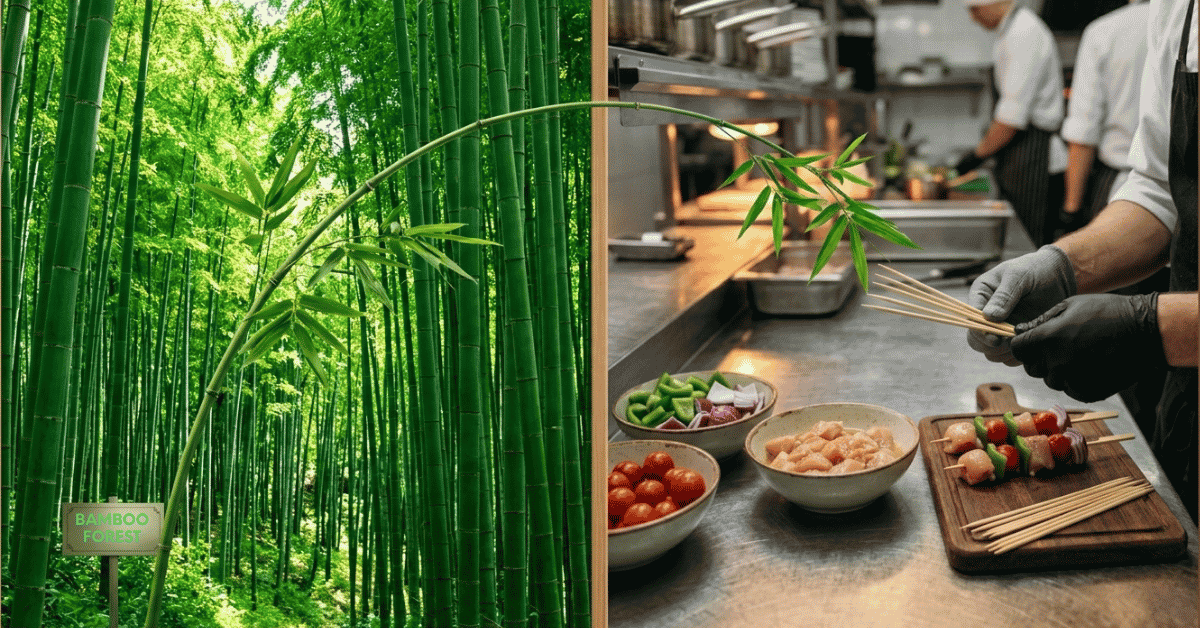
We harvest 4-5 year Moso bamboo exclusively from our own 666-acre forest in Fujian. By avoiding brokers, we eliminate age and quality fluctuations from the very start.The "Middle-Cut" Rule:
We only use the prime middle sections of the bamboo culm for our skewers. While using the whole plant would reduce our costs, only the middle section provides the uniform density required for professional food-grade bamboo skewers.Precision Finishing:
Every batch undergoes double-polishing and automated infrared scanning to ensure it meets our bamboo skewer manufacturing standards. We’d rather invest more in production than have a single splinter reach your kitchen.These choices mean we aren't always the cheapest, but we are the partner you never have to worry about.
To learn more about the structural science behind these standards, read our guide: Eliminating Breakage: How the "Middle Cut" Secures Your Supply Chain.
Contact us today for a comparison kit and experience the difference of a true manufacturing partner.