Eliminating Breakage: How the "Middle Cut" Secures Your Supply Chain

There is a quiet, rhythmic certainty in a bamboo grove at dawn, where nature builds resilience centimeter by centimeter. For those managing global supply chains, this natural variation is the ultimate challenge: every shipment is a silent promise of quality, yet the difference between a satisfied client and a costly quality claim often comes down to a few centimeters of fiber.
While it is easy to view a bamboo skewer as a simple commodity, the reality of a broken batch—and the erosion of trust that follows—is a burden no procurement professional should carry. True reliability isn't a matter of luck; it is rooted in a fundamental respect for the anatomy of the plant, ensuring that the "Middle Cut" turns a gamble into a guarantee.
The Science of Selection: Why Sections Aren't Interchangeable
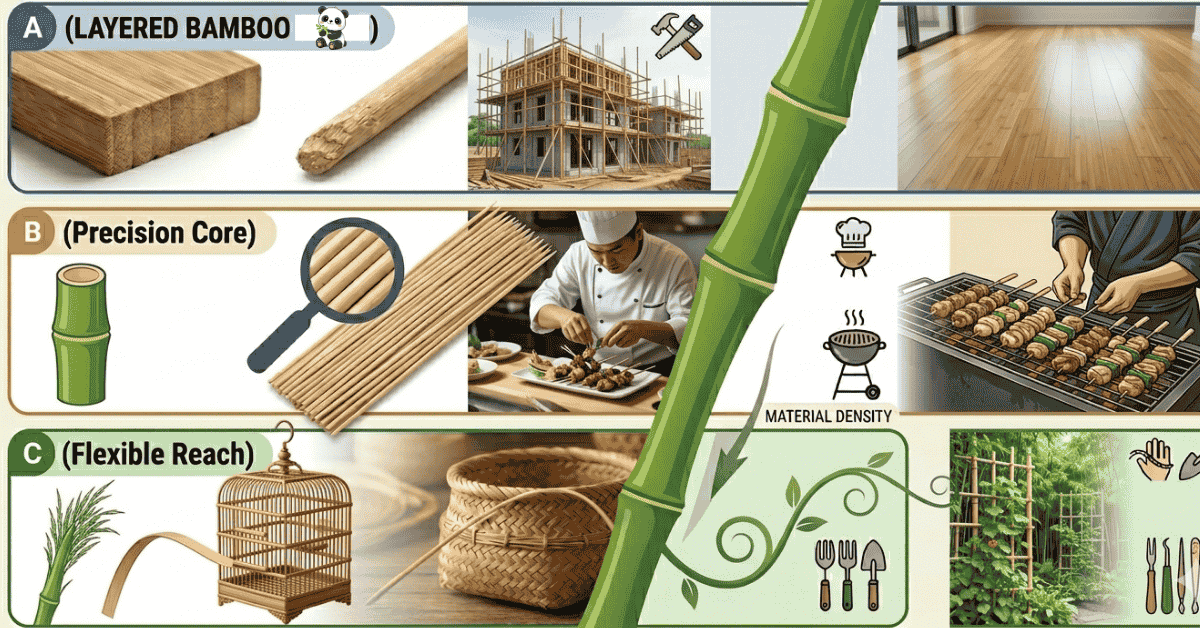
A single Moso bamboo stalk contains three distinct material grades. Identifying and segregating these is the first step in aligning a product with global market demand, ensuring that every piece serves its true purpose:
The Dense Foundation (Bottom):
Built to support 60 feet of vertical weight, this section possesses the most concentrated fibers and the thickest culm walls.Ideal Applications: This heavy-duty grade is the gold standard for strand-woven flooring, outdoor decking, and structural furniture panels.
Supply Chain Insight: While heroically strong for construction, these fibers are too stiff for precision utensils. Using bottom-cut material for skewers often results in products that are prone to vertical splitting and unnecessarily heavy, inflating international shipping costs without adding functional value.
The Precision Core (The "Middle Cut"):
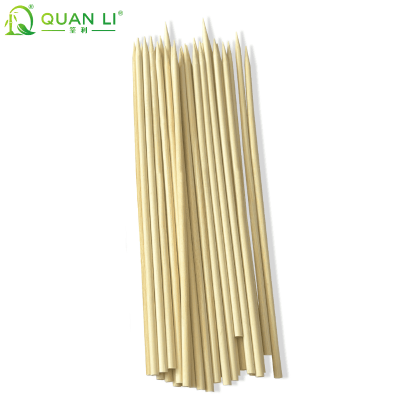
This is the "Goldilocks Zone" of the bamboo stalk. Here, the fibers have reached peak maturity, offering the ideal balance of tensile strength and flexibility.Ideal Applications: This is the exclusive source for premium BBQ skewers, fruit picks, and high-tensile cutlery.
Supply Chain Insight: The internode length is at its maximum here, allowing for perfectly straight, silky-smooth products. Skewers sourced from the middle cut glide through dense proteins without splintering—the key to maintaining client loyalty and zero-claim batches.
The Flexible Reach (Top):
The youngest part of the plant is thin-walled, light, and spirited. While it lacks the "hardening" of the lower sections, it offers incredible pliability.Ideal Applications: This section is best suited for intricate weaving, garden stakes, and lightweight stirrers.
Supply Chain Insight: If a manufacturer mixes top-cut material into a skewer order to save costs, the result is a high percentage of "soft" sticks that fail mid-service. Avoiding this grade is the most direct way to minimize "in-box" waste.
The Factory Divide: Selectivity vs. Survival
The difference between a world-class manufacturing partner and a small-scale workshop isn't just square footage—it's industrial-scale selectivity. Small operations often purchase limited raw material from brokers and cannot afford any waste. To survive, they must turn almost every inch of a bamboo culm into a sellable product, mixing brittle top sections and overly dense bases into the same production line. This results in a "lottery" for the buyer. A partner with large-scale forest management, however, has the luxury of saying "no" to subpar sections, diverting them to other industries so that only the optimal internodes are reserved for premium production.
Why Selective Sourcing Protects Your Margins
In high-volume procurement, the "cheapest" quote often carries the highest hidden risks. The true value of a shipment lies in its usable yield.
Consider the math:
If a lower-cost batch contains mixed-section bamboo, it may result in a 10-15% breakage rate during commercial use. When factoring in the cost of wasted inventory, the labor of sorting, and the potential for rejected orders, the "effective cost" of a cheaper product often far exceeds that of a premium, middle-section shipment. Selective sourcing ensures that the bulk inventory remains consistent and that every case paid for is a case that can be used.The "Node" Factor: Safeguarding Brand Integrity
The nodes (the rings along the stalk) are nature's structural knots. They are significantly harder and more irregular than the rest of the plant, creating physical weak points where breakage is most likely to occur. Utilizing precision technology to bypass these nodes entirely is a commitment to the "hard way" of manufacturing. It results in a silky-smooth finish that protects the end-user and, by extension, the distributor's reputation in a competitive global market. In a world of shortcuts, these details are what build a brand's integrity.
The Reputation Cost: Building for the Long Term
Beyond the immediate math of breakage, there is the long-term cost of reputation. A splinter or a snapped skewer isn't just a lost unit; it is a negative experience for the diner and a significant headache for the food service manager. These "micro-failures" accumulate, eventually leading a client to look for a more reliable supplier. By matching each section of the bamboo to its best possible use, a manufacturer provides the stability that allows a distributor to build a brand on a foundation of trust. Consistency today is the only way to ensure growth tomorrow.
Supply Chain Certainty Over Short-Term Savings
Managing hundreds of hectares of dedicated forest isn't just about scale; it's about providing certainty. When a partner controls the raw material from the soil up, the unpredictability of the market fades. There is a profound peace of mind in knowing that the product received today will have the same density, color, and strength as the one received next year. This consistency allows procurement teams to focus on expansion rather than troubleshooting basic inventory. A reliable product should be invisible—performing its job so perfectly that the focus remains on the client's growth.
A Partnership in Stability
Quality sourcing is an investment in long-term peace of mind. A sourcing partner should work for a business, not create more quality-control work for it. Staying selective ensures that the pulse of the supply chain remains steady, predictable, and strong. It is about moving beyond a simple transaction and toward a shared value for the materials provided by the earth.
Let's Connect
Consistency is the most valuable asset in any supply chain. If you value a partner who respects the logic of the forest as much as the logic of the market, we invite you to explore a more stable path forward:
[Compare Professional Samples] – Experience the strength and smoothness of internode-only sourcing.
[Learn More About the Process] – A transparent look at the standards that ensure a stable, high-volume supply.
[Explore the Full Range] – Discover bamboo solutions designed for high-volume, zero-waste performance.