How to Find a Reliable Bamboo Coffee Stirrer Manufacturer in China
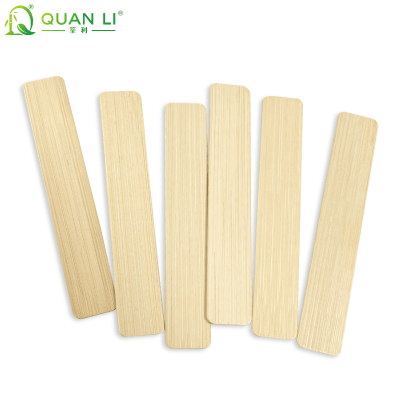
Short answer: a reliable bamboo coffee stirrer manufacturer in China can show you, with evidence, who produces the stirrers, how dimensions and surface quality are controlled, which food-contact documents cover your product and destination market, and whether bulk production will match the approved sample. Verify each point with samples, written specifications, test reports and factory video or audit before you place a bulk order. This guide is written for importers, distributors, coffee supply wholesalers, foodservice suppliers and private-label brands. It covers seven verification factors, a sample approval process, a method for comparing quotations, and a checklist you can paste straight into your next inquiry. A bamboo coffee stirrer looks simple: a flat, narrow stick cut to length. That is exactly why sourcing mistakes go unnoticed until a container arrives. For importers, wholesalers, coffee chains and foodservice distributors the usual problems are small and expensive, and none of them are visible in a product photo: Price and sales claims will not reveal any of this. What reveals it is evidence: a written specification, a measured sample, a document you can read, and a factory that is willing to be watched while your order is made. A reliable manufacturer demonstrates consistent product quality, transparent production capability, food-contact documentation relevant to your product and market, dependable bulk supply, and clear written communication. The key word is demonstrates. Each of these should be something you can request evidence for or see for yourself. A supplier that welcomes detailed questions, puts specifications in writing and is comfortable with sample testing is usually easier to work with than one that answers everything with 'no problem'. Evaluate what the supplier can demonstrate, not simply what its website claims. Confirm who actually controls production and inspection for your order. Trading companies can be useful for small, mixed orders. For repeat bulk orders with a fixed specification, however, it matters who can trace a problem to a production batch and fix it at the source. Check whether the supplier can explain its process — cutting, polishing, drying, packing — and its equipment in specific terms, and whether it is open to a live video call, third-party audit or visit. Ask how raw bamboo is selected and sorted, because variation in the material shows up in the finished stirrer. Differences in colour, grain and thickness at the raw-material stage lead to uneven polishing and more rejects later. A bamboo species or age on its own does not guarantee a better stirrer. What matters is the supplier’s selection criteria, the quality of its processing and the consistency of the finished product. For bamboo used in food-contact products, provenance matters on two fronts: whether the material is legally sourced, and whether the supply chain is documented. Most European and North American buyers now ask for FSC chain-of-custody certification, or an equivalent scheme, as part of supplier approval, even where a food-contact test report is already on file. Ask for the certificate number and the scope it covers rather than a logo, and check whether the certificate actually names the products you are ordering. Certification is not a substitute for food-contact testing: one proves how the material was sourced, the other proves that the finished item meets the limits for your market. Put length, width, thickness and surface requirements in writing, then measure them yourself. Measure with calipers and compare against the specification. Inspect both faces, the edges and the ends for splinters, cracks and rough spots. Check a meaningful number of pieces from different bags or cartons, not a handful chosen by the supplier. Ask what tolerance the factory works to and how it checks it. Choose the specification around your use: cup height, the beverage, and for vending, the dispenser’s mechanism. Ask for product-specific test reports and check that they cover your product and destination market. For each document, check the product and material named, the scope, the test methods, the date and the market it was written for. Requirements differ between the EU, the US, Japan and other markets, so a report suitable for one may not satisfy another. A useful test is simply: does this document cover my product? Also separate two kinds of paper. A product test report relates to the item itself. A factory management certificate relates to systems and processes. Both can be useful, but one does not replace the other. A mention of FDA, SGS or LFGB on a website is not proof that a specific stirrer complies, so ask which report applies, to which product, and with what scope. Your importer or compliance adviser should confirm what your market requires. Useful references: EU food contact materials, US 21 CFR Part 174 and German LFGB. Ask the supplier to confirm capacity and lead time for your SKU, not factory-wide figures. Factory size and machine counts are useful context, but they do not prove that a specific product can ship on your schedule. Ask for the capacity for your stirrer size, the MOQ for standard versus customised orders, how the supplier plans for peak season, and whether capacity can be reserved against a forecast. If you expect repeat orders, ask how the specification is kept identical from one order to the next. Match the packaging to your sales channel, and confirm that any custom work is covered by a sample. Bulk packs suit wholesalers and foodservice distributors. Individually paper-wrapped stirrers suit hygiene-conscious venues. Custom retail boxes and private labelling suit branded programmes. Ask how a logo is applied — for example hot stamping or laser engraving, where offered — what artwork the factory needs, and what the MOQ is for custom work. Bamboo is a natural material that responds to humidity, so also ask how cartons are sealed and packed to survive storage and sea freight. How a supplier behaves during quotation and sampling is a preview of how it will behave in production. Look for answers that address your actual questions, specifications confirmed in writing, a realistic production lead time and clear shipping arrangements. Ask in advance how defects, specification changes and repeat orders are handled, and whether the supplier follows up after delivery. Use this table to review your shortlist once you have worked through the seven factors. A flawless sample means little unless you test it properly and carry the result into production. Follow this process before you approve a bulk order. A good sample is only the starting point. The supplier must reproduce the agreed specification in bulk production. Wholesale pricing follows specification, volume and packaging, so a single market price is not meaningful. The more useful question is what exactly a quotation includes. This section therefore focuses on how to get quotations you can compare fairly. Paste this into your next supplier inquiry and fill in the brackets, so that every supplier quotes on the same basis. Our requirements: length [L] mm, width [W] mm, thickness [T] mm; estimated order quantity [quantity]; packaging [bulk / individually wrapped / retail box]; destination market [country]; branding [none / logo / custom packaging]. Please confirm the answers in writing, together with the quotation. Fujian QL Houseware Manufacturing Co., Ltd (QL Bamboo) is a bamboo products manufacturer based in Shaowu, Fujian Province, China. Its website describes 16+ years of custom bamboo manufacturing, and its company timeline dates the development of bamboo coffee stirrers to 2014. The points below map QL’s published information to the factors above. As with any supplier, verify them for your own product. QL lists standard bamboo coffee stirrer lengths of 110, 140, 178 and 190 mm, two vending-machine sizes of 90 × 9 × 1.3 mm and 105 × 9 × 1.3 mm, and OEM/ODM custom lengths from 11 to 19 cm. As a rule of thumb, taller cups and cold drinks call for longer stirrers, while small cups and many vending applications call for shorter ones. For vending, confirm the size against the dispenser’s specification. The full range is on the bamboo coffee stirrers product page. QL states that its bamboo comes from its own 666-hectare forest, and its website lists a 42,000 m² factory with 138+ automatic machines. Its production pages describe cutting, polishing, drying, packing and quality inspection. You can see the process on the production process page and in the QC system video. For inspection standards and records, ask QL for the procedures that apply to your specific order. QL offers individually paper-wrapped stirrers, bulk PE bags and premium boxes, with logo marking available. In practice, individual wrapping suits cafés and venues that prioritise hygiene, bulk bags suit distributors and foodservice supply, and boxes suit retail and private-label programmes. Contact QL to confirm sample availability and any applicable charges for standard and custom samples. For documents, ask QL for the applicable product test reports and declarations, and confirm that their scope matches your product specification and destination market. To request samples or a quotation, send through the QL contact page or to ql@qlbamboo.com: Related reading: browse more buyer guides in the QL bamboo coffee stirrers blog category, or see what buyers look for in a bamboo coffee stirrer supplier and how to find a reliable bamboo skewer manufacturer. The fastest way to a comparable quotation is to give every supplier the same specification. State the length, width and thickness, your estimated quantity, the packaging format, the destination market and any branding requirement, and ask for the answer in writing. Send: length / width / thickness · estimated quantity · packaging format · destination market · branding requirements. Ask for: product-specific food-contact documents for your market, capacity and lead time for your SKU, sample charges and lead time, and the reference specification kept on file for repeat orders. Request a quote for your bamboo coffee stirrer specification or browse the full bamboo coffee stirrer range. Shortlist manufacturers, then verify each one with evidence rather than claims. Confirm who produces the stirrers, watch factory footage, request product-specific test reports, test samples against a written specification, and compare quotations built on identical specifications. Look for consistent dimensions and surfaces, documents that cover your product and market, a confirmed MOQ and lead time, suitable packaging, and clear written communication. Support each point with a written specification sheet and an approved sample. Bamboo stirrers are commonly used in hot coffee and tea, but suitability depends on your beverage temperature, cup and stirring time. Test samples in your actual drinks, check the surface afterwards for roughness or splinters, and ask the supplier for any relevant test data. QL lists standard lengths of 110, 140, 178 and 190 mm and vending sizes of 90 × 9 × 1.3 mm and 105 × 9 × 1.3 mm, with custom lengths of 11 to 19 cm available. See the product page for the full range, and confirm width, thickness and tolerance for your use. Yes, QL offers OEM/ODM customisation of size, logo marking and packaging, including individual paper wrapping, bulk PE bags and premium boxes. Send your artwork, dimensions and quantity so QL can advise on samples and MOQ. Request product-specific food-contact test reports for your destination market, a specification sheet and packaging details. For import clearance you will also need standard commercial documents such as an invoice and packing list, so ask your customs broker or compliance adviser which market-specific documents apply. The MOQ for bamboo coffee stirrers depends on the size, order quantity, packaging format and customisation requirements. When requesting a quotation, specify whether you need a standard product or a custom design, and ask the manufacturer to confirm the MOQ, sample availability and lead time in writing. Test multiple samples against a written specification before approving anything. Measure dimensions, inspect surfaces, test in real use, approve one final sample in writing, agree bulk inspection requirements, and keep the approved sample as a reference for repeat orders.
Why Choosing the Right Bamboo Coffee Stirrer Manufacturer Matters
What Makes a Reliable Bamboo Coffee Stirrer Manufacturer in China?
1 Verify the Manufacturer and Its Production Capabilities
What to Check on Factory Capability
Evidence to Request from the Factory
2 Check Bamboo Material and Product Consistency
What to Check in Bamboo Material Selection
Evidence to Request on Material Consistency
3 Confirm Dimensions, Surface Finish and Tolerances

What to Check on Dimensions and Surface
Evidence to Request for Measurement Records
4 Review Food-Contact Documentation
What to Check in Food-Contact Documents
Evidence to Request for Compliance Reports
5 Evaluate Bulk Production and Repeat-Order Reliability
What to Check on Bulk Production Capacity
Evidence to Request for Capacity Records
6 Confirm Packaging and Customization Options
What to Check on Packaging and Customization
Evidence to Request for Packaging Samples
7 Assess Lead Times, Communication and After-Sales Support
What to Check on Lead Time and Support
Evidence to Request Before You Commit
Quick Reference: Bamboo Coffee Stirrer Supplier Evaluation Table
Evaluation factor What to verify Evidence to request Factory capability Who controls production? Factory tour or production records Product quality Are dimensions and surfaces consistent? Samples and specification sheet Food-contact compliance Does the documentation cover the intended product? Relevant test reports Bulk supply Can the order meet the delivery schedule? Written production plan Packaging Does the format match the intended sales channel? Packaging samples Quality control How are defects identified? Inspection procedures and records Communication Are requirements and changes confirmed clearly? Written quotation and order confirmation 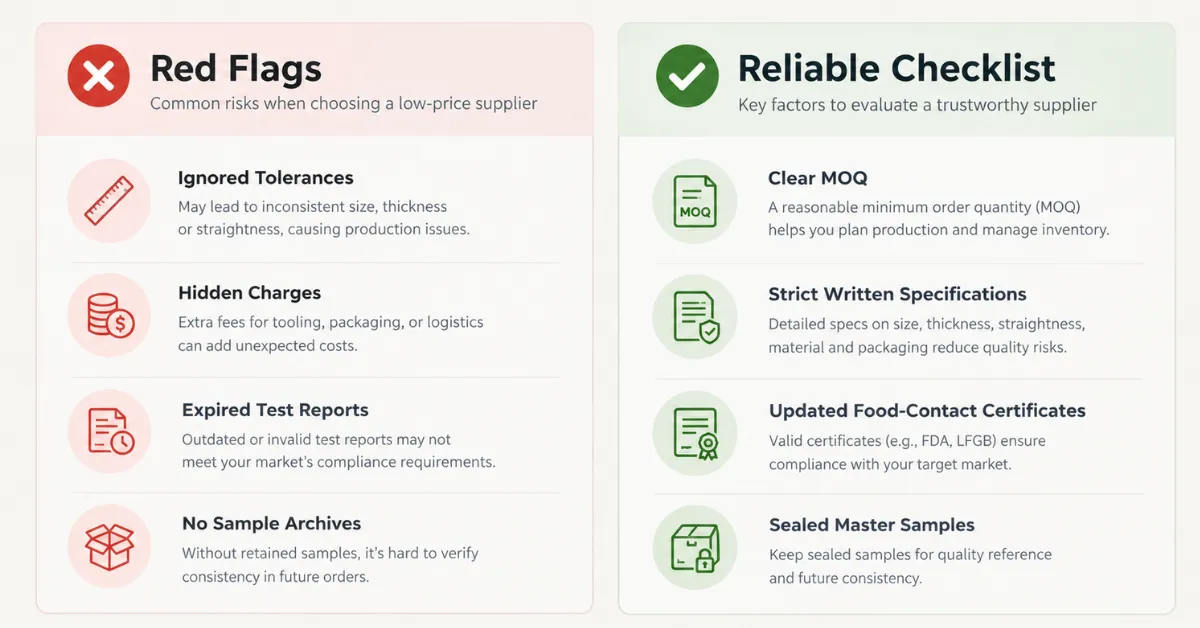
How to Check Bamboo Coffee Stirrer Quality Before Placing a Bulk Order
A Six-Step Sample Approval Process

How Can You Reduce the Risk of Sample-to-Bulk Differences?
How Much Do Wholesale Bamboo Coffee Stirrers Cost?
What Factors Affect the Quotation?
How Should Buyers Compare Manufacturer Quotations?
Copy-and-Paste Inquiry Checklist: 10 Questions to Ask Before Ordering
How QL Bamboo Can Help Buyers Evaluate a Supplier
Product Specifications
Stirrer type Available sizes Typical use Standard lengths 110 mm, 140 mm, 178 mm, 190 mm Cups, mugs, tall glasses and cold drinks Vending machine sizes 90 × 9 × 1.3 mm, 105 × 9 × 1.3 mm Confirm against the dispenser specification OEM / ODM custom 11 cm to 19 cm Private-label programmes and branded packaging Manufacturing and Quality Control
Packaging and Customization
Samples and Documentation
Send Your Specification for a Targeted Quotation
Frequently Asked Questions
How do I find a reliable bamboo coffee stirrer manufacturer in China?
What should I look for in a bamboo coffee stirrer supplier?
Are bamboo coffee stirrers suitable for hot drinks?
What sizes are available for wholesale bamboo coffee stirrers?
Can I order custom bamboo coffee stirrers with private-label packaging?
What documents should I request when importing bamboo coffee stirrers?
What is the MOQ for bulk bamboo coffee stirrers?
How can I check the quality of bamboo coffee stirrers before mass production?