2026 Plastic Ban Updates for Bamboo Buyers
Single-use plastic rules are tightening in several major markets during 2026, and the change is not only about which products may be sold. In some places it is about how those products may be provided. This briefing covers the five developments most likely to affect bamboo foodservice supply chains, and what importers of disposable tableware should verify before placing bulk orders.
What changed in 2026? Angola banned single-use plastic items under 0.05 mm on 22 September 2026, the United Arab Emirates started the second phase of its nationwide plastic ban on 1 January 2026, and New Jersey's “Skip the Stuff” law took effect on 1 August 2026. In Australia, Queensland's exemption for plastic attached to pre-packaged food ended on 31 December 2025, while Türkiye is finalising a draft regulation expected to be implemented by the end of 2026. For buyers, the practical action is the same in every case: confirm which rule applies in the destination market, then verify the material declaration, food-contact documents and supply terms for the exact product you are buying.
01 Key Regulatory Developments in 2026
Five markets are worth watching for importers of disposable tableware, and they are not all the same kind of rule. Angola and the United Arab Emirates regulate by material, New Jersey regulates by supply method, Australia works state by state, and Türkiye is still in the consultation stage. The table below summarises each one; the sections that follow add the detail buyers usually need.
| Market | Measure | Effective date | What it means for bamboo buyers |
|---|---|---|---|
| Angola | Ban on single-use plastic items under 0.05 mm, plus plastic straws, drink stirrers and cotton buds with plastic stems | 22 September 2026 | Import licences for covered plastic items are not being issued, so check the thickness of any plastic line before allocating supply |
| United Arab Emirates | Second phase of the nationwide ban: cups and lids, cutlery, plates, straws, stirrers, Styrofoam food containers, plus all bags under 50 microns | 1 January 2026 | Import and manufacturing licences for covered plastic lines are withdrawn; goods made solely for export remain exempt |
| United States (New Jersey) | “Skip the Stuff” law: utensils, straws and condiments only on request, with online ordering defaulting to none | 1 August 2026 | Not a material ban, so fulfilment design and packaging matter as much as the material you choose |
| Australia (Queensland) | Time-limited exemption for plastic items attached to pre-packaged food ends | 31 December 2025 | Plastic straws and utensils in shelf-ready packs are no longer exempt, so pre-packaged applications need a separate review |
| Türkiye | Draft regulation phasing out listed single-use plastics, modelled on the EU Single-Use Plastics Directive | Expected by end of 2026; the draft sets 1 September 2026 for market supply | Treat as pending and confirm the final text and effective date before changing supplier allocations |
Angola: thin-film and single-use items banned from 22 September 2026
Angola started implementing the first phase of its national plan to eliminate single-use plastics on 22 September 2026, under Presidential Decree No. 170/25 and the National Plan for the Progressive Phase-out of Single-Use Plastics (PLANEPP) 2025–2027. The measure prohibits the production, import, sale and use of single-use plastic bags thinner than 0.05 mm, together with plastic straws, drink stirrers and cotton buds with plastic stems, and the same restrictions apply on beaches, in conservation areas, in museums and at heritage sites. The 50-micron threshold also shapes what the rest of the market may use: below that thickness, items such as bottles, cups, cutlery and tableware are effectively off the market. Producers and other market operators receive a 12-month grace period, and the Government has stated that import licences will not be issued for the affected products. Penalties under the plan range from 25,000 to five million kwanza for individuals and from one million to 300 million kwanza for companies. Importers should confirm the detailed product list and the applicable exemptions with the National Authority for Economic Inspection and Food Safety (ANIESA) before shipping.
United Arab Emirates: expanded restrictions from 1 January 2026
The United Arab Emirates brought the second phase of its nationwide ban on the import, manufacture and trade of single-use consumer plastics into force on 1 January 2026, under Ministerial Decision No. 380 of 2022 issued by the Ministry of Climate Change and Environment. The phase adds beverage cups and their lids, cutlery such as spoons, forks, knives and chopsticks, plates, straws, stirrers, and food containers and boxes made of Styrofoam, and it also bans single-use bags of any material, including paper, below 50 microns. Phase one, in force since 1 January 2024, had already prohibited single-use plastic shopping bags. A set of exemptions keeps trade flowing: products manufactured solely for export or re-export, items made from recycled material within the UAE, medicine bags, refuse bags, very thin bags used to wrap fresh food, and large shopping bags intended for clothing, electronics and toys. Foodservice suppliers should review the requirements line by line before making sourcing decisions, because the exemptions are defined by product, material and end use rather than by category alone.
United States: New Jersey's “Skip the Stuff” law
New Jersey's “Skip the Stuff” law took effect on 1 August 2026, having been enacted in January 2026 as Senate Bill 3195. It is a supply-mechanism measure rather than a material ban: single-use utensils, condiment packets and plastic straws may only be provided when the customer specifically asks for them, and online ordering systems and delivery platforms must default to no utensils or condiments. Full-service restaurants with seating for at least ten customers must provide reusable utensils for dine-in service, while self-serve dispensers remain permitted as long as they dispense individual items rather than bundled cutlery packs. Exemptions cover K-12 schools, licensed healthcare facilities, county and state correctional facilities, food court vendors until 1 August 2028, pre-packaged items with utensils attached, and single-use sauce cups for dine-in service. NJDEP guidance sets escalating penalties: a warning for a first violation, a fine of up to 100 US dollars per day for a second, and up to 250 US dollars per day for third and subsequent violations within a twelve-month period. For suppliers, the point to note is that the law changes how items reach the customer rather than what the item is made of, so bundle design, packaging instructions and fulfilment defaults deserve the same attention as the material itself.
Australia: state-level restrictions continue
Australia's plastic regulations vary by state and territory, so a national answer is not a safe one. In Queensland, an exemption covering certain plastic items attached to pre-packaged products ended on 31 December 2025, which means a plastic straw in a pre-packaged juice box or a plastic spoon in a yoghurt tub is now banned alongside the state's long-standing prohibition on single-use plastic straws, stirrers, cutlery, plates and unenclosed bowls. Other jurisdictions have moved on the same shelf-ready exemption, with South Australia setting an expiry of 1 September 2025 and Victoria 1 January 2026, while disposable coffee cups and lids remain on Queensland's published roadmap. A blanket exemption continues to apply to the supply of banned items for people with a disability or a healthcare need. Businesses supplying packaged food and beverages should check the relevant state and territory requirements for each product line rather than assuming the position is consistent across the country.
Türkiye: proposed restrictions require monitoring
Türkiye has reported plans to introduce restrictions on disposable plastic products, including cutlery, plates and straws. The Ministry of Environment, Urbanisation and Climate Change is finalising a regulation modelled on the EU Single-Use Plastics Directive, as part of the Zero Waste Project, and the ministry is targeting implementation by the end of 2026; the draft circulated in 2026 sets 1 September 2026 as the date from which the listed products can no longer be placed on the market. The scope covers plastic cutlery, plates, straws, beverage cups, stirrers, expanded polystyrene food containers and cotton buds with plastic stems, and the draft also brings biodegradable, compostable and recycled plastics within the prohibition. The ministry estimates that phasing out the targeted products could avoid around 1.5 million tonnes of carbon dioxide equivalent emissions each year and save close to 1.5 billion Turkish lira in waste management costs, against 2022 consumption of more than 709,000 tonnes of single-use plastic. Because the text is still moving through consultation, buyers should confirm the final regulation and its effective date through official sources rather than relying solely on preliminary media reports.
02 What This Means for Bamboo Product Buyers
These developments highlight the importance of reviewing product materials and destination-market requirements before placing bulk orders. Natural bamboo products, including bamboo cutlery, coffee stirrers and skewers, may offer alternatives for selected foodservice applications, and bamboo sits outside the plastic bans described above. However, buyers should verify the specific rules applicable to each market and product, because a material-based ban, a thickness-based restriction and a supply-mechanism rule create three different compliance tasks. When evaluating suppliers, consider three essentials:
- Material verification. Request a clear material declaration and the relevant test reports. A supplier should be able to state the material, the food-contact documentation that covers it and the destination markets it is intended for, and those documents should match the item being shipped rather than a similar product.
- Product quality. Confirm dimensions, surface finish, strength and application requirements. It also matters how the product reaches the customer: an item served loose, one packed with a meal and one pre-attached to packaging are treated differently by rules such as New Jersey's, and the specification should say which case applies.
- Supply reliability. Agree on samples, packaging, lead times and quality standards before mass production, and confirm which inspection points are recorded so that a shipment can be checked against the approved sample if a question is raised after delivery.
03 How Bamboo Fits These Rules, and Where It Does Not
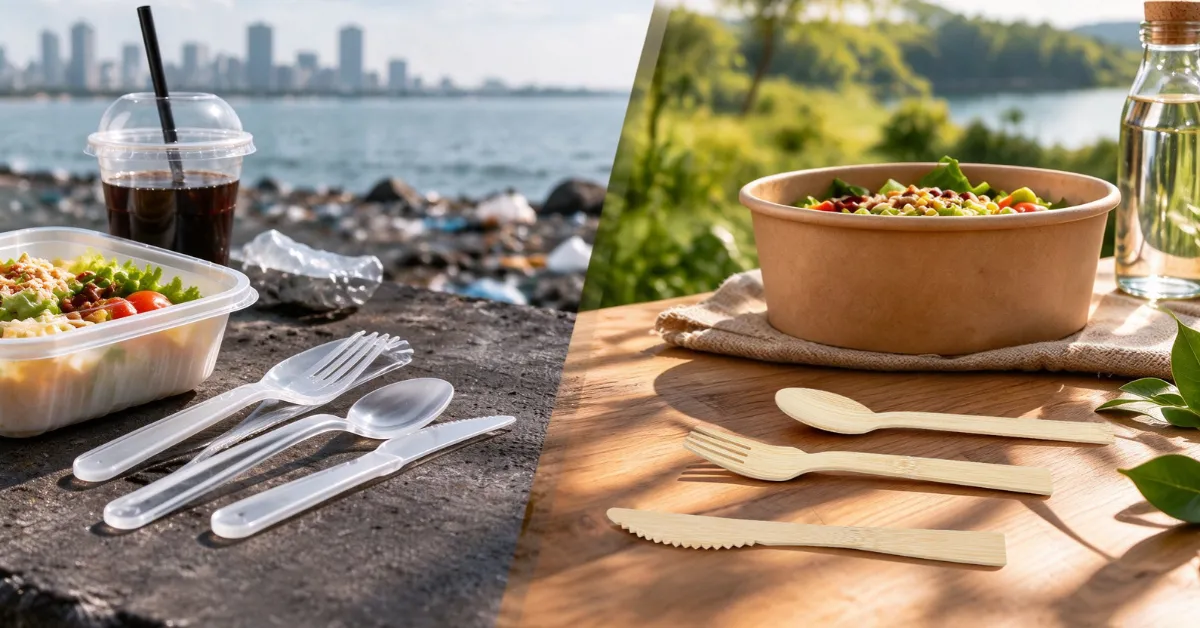
Bamboo is a natural material, so it is not caught by a ban written around plastic. That makes it a practical alternative wherever a restriction names plastic cutlery, cups, straws, stirrers or food containers. It does not make a product compliant by default: compostability claims, food-contact documentation, labelling and packaging format remain the buyer's responsibility in every market, and a rule that is written about behaviour rather than material still applies to bamboo.
Where bamboo is a direct substitute
Where a rule names plastic cutlery, cups, straws, stirrers or food containers, a bamboo equivalent can usually be specified without changing the rest of the foodservice operation. Bamboo forks, knives, spoons and chopsticks, coffee stirrers and hot-food containers can cover the categories targeted in markets such as the United Arab Emirates, and in New Jersey they meet the request-based model of the “Skip the Stuff” law without changing how the item is supplied.
Where bamboo is not a substitute
A plastic ban does not cover every disposable item. In New Jersey the obligation is procedural: the item must be requested rather than supplied automatically, whatever it is made from. In Queensland, the exemption that ended in December 2025 applied to plastic attached to pre-packaged food, so a bamboo product in the same pack still needs its own review. Rules on labelling, on compostability claims and on food-contact compliance apply regardless of material, and they are the part buyers most often miss.
04 Sourcing Bamboo Tableware with QL Bamboo
QL Bamboo specialises in bamboo products for foodservice and related applications, including bamboo skewers, coffee stirrers, cutlery and other disposable bamboo items. With more than 16 years of industry experience and manufacturing in Nanping, Fujian, one of the richest bamboo-growing regions at this latitude, QL supports buyers evaluating product specifications, customisation and bulk supply requirements.
- 666+ hectares of managed bamboo forest, supplying moso bamboo harvested at more than five years of age for strength and a low defect rate
- 88,600 square metres of production space, with a 10,000 square metre covered warehouse holding more than 7,500 pallets
- 138+ machines and annual shipping capacity of more than 720 containers, supported by a 65+ person production team
- 300+ customers served, with 99% customer satisfaction reported on site
Planning a bulk order against the 2026 rules? Send your specification, destination market and annual volume to the QL team, or browse the full bamboo product range first.
05 Frequently Asked Questions
Which single-use plastic rules are taking effect in 2026?
Five markets matter most for bamboo foodservice supply chains: Angola from 22 September 2026, the United Arab Emirates from 1 January 2026, New Jersey from 1 August 2026, Australia's state-level bans with Queensland's shelf-ready exemption ending on 31 December 2025, and Türkiye with a draft regulation expected by the end of 2026.
Does the UAE single-use plastic ban cover bamboo cutlery?
No. The ban applies to plastic products such as cups and lids, plastic cutlery, plates, straws, stirrers and Styrofoam containers. A bamboo equivalent is not a plastic product, but it still has to meet food-contact requirements and any other rule that applies to disposable tableware in the destination market.
Is New Jersey's Skip the Stuff law a plastic ban?
No. It is a supply-mechanism rule. From 1 August 2026, single-use utensils, straws and condiment packets may only be provided on customer request, and online ordering must default to no utensils or condiments, regardless of the material used.
Which exemptions should importers check first?
The most common exemptions are export-intended goods and items made from recycled material in the UAE, food court vendors and healthcare settings in New Jersey, and institutional exemptions for schools and correctional facilities. The Angolan plan also grants producers and market operators a 12-month grace period.
What documentation should a bamboo supplier provide?
Ask for a clear material declaration, food-contact test reports that cover the exact product and the destination market, and confirmation of dimensions, surface finish and strength against your own specification. The documents must match the SKU being shipped, not a similar one.
How should buyers plan a bulk order around these rules?
Confirm which rule applies in the destination market first, then specify the bamboo product, then verify documentation and supply capability. Where a measure is still in draft, such as Türkiye's, keep current allocations until the final regulation and its effective date are published.
06 Related Bamboo Products and Reading
The categories below are the ones most often specified against plastic alternatives in foodservice. If your order covers several of them, it is worth quoting them together so that documentation, packaging and lead times can be handled as one order rather than several.
- Bamboo CutleryDisposable bamboo forks, knives, spoons and chopsticks for takeaway and catering.
- Bamboo SkewersBamboo skewers in a range of lengths and thicknesses for grilling and food prep.
- Bamboo Coffee StirrersCoffee stirrers sized for hot and cold drinks, packed for high-volume foodservice.
- Bamboo StrawsBamboo drinking straws as a natural alternative to plastic straws.
- Bamboo Ice Cream SticksIce cream sticks and spoons produced for frozen dessert producers.
- Bamboo Food PicksCocktail picks, fruit picks and other small serving accessories.
- Bamboo ToothpicksToothpicks and dental-care picks in standard and custom formats.
- Bamboo ChopsticksDisposable bamboo chopsticks for Asian food service and takeaway.
Further reading from QL Bamboo
- Bamboo Cutlery and PPWR: Is It a Future-Proof Choice for EU Buyers?
- How to Find a Reliable Bamboo Skewer Manufacturer in China: 2026 Buyer's Guide
- What Should Buyers Look for in a Bamboo Coffee Stirrer Supplier?
- What are the usage and benefits of biodegradable bamboo cutlery?
- Bamboo Tableware FAQ: material, compostability and food-contact questions answered
- About QL: bamboo forest resources, production and quality control
Regulations and exemptions vary by market and are revised over time, and several of the measures summarised here are still moving through consultation. This summary is a buying orientation rather than legal advice. Buyers should consult the relevant official authorities for current requirements before importing products, and confirm the final text and effective date of any measure that remains in draft.